

Nine months from now, the next set of water companies will start delivering some of their communities' most critical services. For boards, incoming executives, and establishment teams, that date is approaching fast. Jessie Larsen explains why the biggest challenge for them is making sure they’re focussed on the work that matters most for Day 1.
Nine months might be long enough to grow a human but it’s not long to build a water company and prepare it to provide services. Given that time crunch, the successful establishment programmes won’t be the ones that have ticked off the most deliverables, they’ll be the ones that have been tightly focussed on what matters most for Day 1.
Building a new organisation creates energy and opportunity. Leaders will want to shape a new culture and design better services, so they can realise the long-term promise of reform. That ambition is important, but it risks distracting attention from today’s primary job: getting the company running safely, legally, and reliably from Day 1.
The next nine months are about disciplined choices
When the runway is short, we need to sort the basics from the bells and whistles.
Day 1 readiness doesn’t require every capability of the new company to be fully developed, just those that underpin your most critical processes. Reaching for full establishment on Day 1 could put you at risk of falling short on the fundamentals.
To ensure your establishment work is focussed on what’s most critical for Day 1 readiness, prioritise into three buckets the building of your different organisational capabilities, like people, technology, data, and processes:
- What must be fully ready to operate on Day 1 – Critical processes like collecting revenue, managing customer queries, managing faults or incidents, and paying staff and suppliers are likely to need fully built capabilities across the end-to-end process to manage risk and meet expectations.
- What could be delivered partially or managed through temporary workarounds – For other less critical or time-sensitive processes it may be fine to use a spreadsheet until a system is ready, or to rely on council experts until your own people are onboard.
- What should wait until later – Some organisational capabilities could be safely built after your go-live. While they won’t be a focus for Day 1, they should be planned for, resourced, and funded for delivery afterwards.
Those distinctions need to be explicit. Boards, programme directors, incoming leaders, and council shareholders need a common understanding of what Day 1 success looks like and the risks they’ve agreed to carry beyond it.

Completion is not the same as readiness
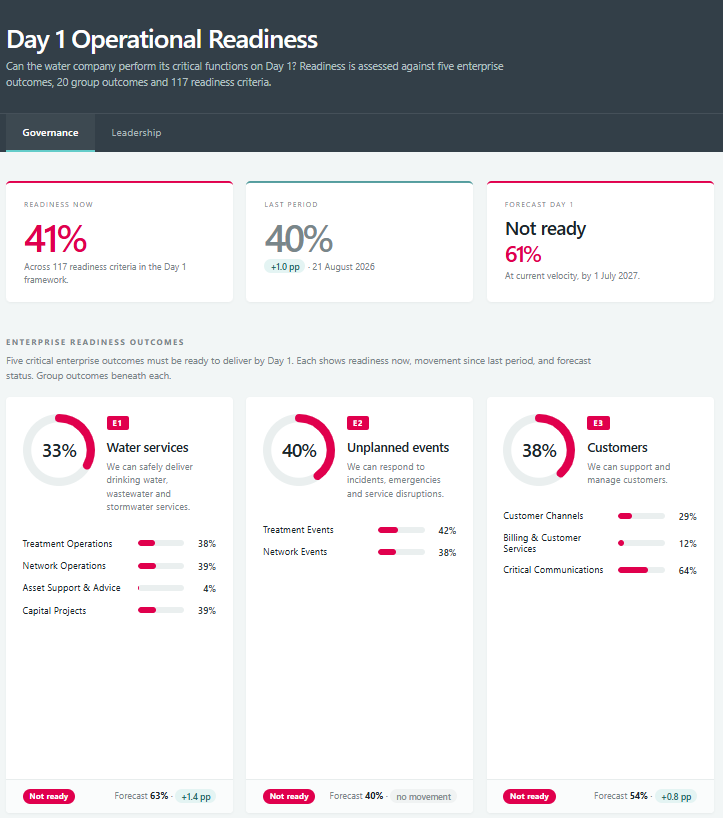
Most establishment programmes have detailed plans and reporting that show what work is underway and whether deliverables are on track. That information is useful, but it doesn’t answer all the questions worth asking. An establishment programme can be on track and yet still the organisation may not be ready.
To be able to operate effectively from Day 1, water companies also need to address these crucial questions:
- Can we safely deliver water services?
- Can we respond when things go wrong?
- Can our customers get the help they need?
- Can we meet our legal and regulatory obligations?
Operational readiness processes need to test your responses to these questions, and the other questions that matter most to you and your customers, using evidence not optimism.
Readiness needs an owner and its own rhythm
Operational readiness often falls into the gap between the establishment team and incoming company leaders. When responsibility is spread across workstreams, each one will report on its own deliverables, but nobody holds the enterprise view.
The best programmes appoint a clear owner for readiness overall. That person connects activity across workstreams, brings business-owner perspectives and evidence into a regular forum, and surfaces emerging risks early enough for them to be acted on.
The rhythm matters as much as the ownership. Readiness checkpoints should start early, be at least monthly, and become more frequent as Day 1 approaches.
Water companies that are already live, and in the establishment phase now, can provide some lessons
In my firm’s work with several water companies that have already gone live, and with some still being established, six readiness themes have emerged.
The common thread is that many Day 1 risks sit between workstreams, organisations, and governance groups, which means they can remain invisible until late in the programme.
1. The impacts on your customers need early attention
Many establishment programmes focus on systems, processes, and operating models before considering what the transition will mean for customers. But Day 1 success will ultimately be judged by whether your customers can pay a bill, report a fault, ask a question, or receive a service without disruption.
If the impacts on customers aren’t built into readiness planning from the start, you’ll risk finding out too late that you can’t properly support your most important stakeholders.
2. Establishment capability is a readiness issue
Readiness depends not just on what’s being built, but also on whether the programme has the necessary capability to build it.
An establishment programme isn’t business as usual. Building a new organisation requires different skills, disciplines, and decision-making approaches from those needed to run an existing one. Without those capabilities, readiness risks are less likely to be identified and addressed early enough.
Too often, establishment programmes rely on operational leaders who may not have experience in complex transformations. These leaders are also expected to absorb the establishment work alongside their day jobs, which usually means that both jobs suffer.

3. An effective council-to-board relationship underpins readiness
A shareholder council and a company board necessarily approach decisions from different perspectives. Readiness on Day 1 depends on each side understanding the other’s role and obligations, and working constructively in the context of that reality.
Councils, for their part, need to understand that company directors have their own legal duties under the Companies Act and other legislation. Transfer agreements and service arrangements are significant transactions, and company boards need to provide appropriate scrutiny and ensure there are proper costings and clear expectations.
In my firm’s work in this area, we see the strongest foundations being laid when shareholding councils are explicit that their goal is to set up the new water company for success. That means working effectively and transparently with the new board to ensure that all the tasks and decisions necessary for these significant transactions happen in good time.
Programmes are more likely to achieve readiness when the council–board relationship is strong enough to resolve issues early, rather than having leaders’ valuable time chewed up in managing conflict.
4. Unclear decision rights undermine readiness
Many readiness risks emerge at the boundaries between organisations, workstreams, and governance groups. Decision rights are highly fluid during the establishment phase, as company executives take up their roles and boards or establishment teams transfer accountabilities.
Progress can stall quickly if it isn’t clear who has authority to make decisions or accept risks. Don’t wait for a major problem to test your decision-making arrangements – early on, agree on clear decision rights and escalation routes and plan for the baton change in transition.
5. Communication readiness is key
Billing problems, service changes, or operational disruptions can generate public concern and attract media attention, and sometimes lead to political or regulatory intervention.
For the organisation to be truly ready, leaders need a shared understanding not just of likely customer impacts, emerging risks, and escalation processes. They also need to pay attention to how they’ll communicate when things go wrong.

6. Shared services need to be readiness-tested
Councils often underestimate what’s needed to become a shared-services supplier to a new water company. Councils need both sufficient internal capacity and the right capabilities to deliver a shared service.
On the water company side, they need to be clear on what responsibilities they need to retain in-house before agreeing to shared-services arrangements.
Readiness assessments should test whether shared-services arrangements are well understood, documented, and appropriately governed. The assessment should confirm that the arrangements are capable of supporting Day 1 operations.
Nine months is just around the corner
If you're involved in establishing a new water services organisation, ask yourself now: Are we measuring operational readiness, or are we just measuring the progress of our establishment programme?
If you’re tending towards the latter, here are three things worth doing this month:
- Appoint a single readiness owner, if you haven’t already.
- Run a Day 1 readiness workshop to agree what ready looks like.
- Schedule your readiness checkpoint sessions through to Day 1.