
If you’re leading through change, there’s usually a point when, although nothing has been formally announced yet, your people have already started reading the signals. Emma Pennington-Foley argues that this is precisely the time for leaders to start leading.
You’ll have seen it and experienced it yourself: it might be the more frequent leadership meetings, or decisions taking longer than before, or it might be the quieter conversations by the coffee machine. Your team has begun to notice small changes in how things are operating.
Nothing has been announced or stated directly, yet people have begun forming a view of what might be coming and what it could mean for them. By the time a formal change process begins, those early interpretations are often already in place.
For leaders, this is often where the tension begins. Although your people have a sense something is moving, you’re understandably cautious about saying too much too soon, because decisions are still being worked through.
The problem is, people are already making sense of what they’re seeing – and they’re doing that whether or not leaders are visible in the process. This shapes their sense of what the change is going to feel like, of how safe they feel it will be to engage with it, and of how much confidence they have in their leaders.
The early phase of change can be less visible but still very consequential
I find it useful to place this initial signal-reading phase in the early part of the change experience, before a programme is fully established and before a clear set of messages has been settled on.
In the framework we use at my firm, it sits in the “Anticipate” stage of the broader process.
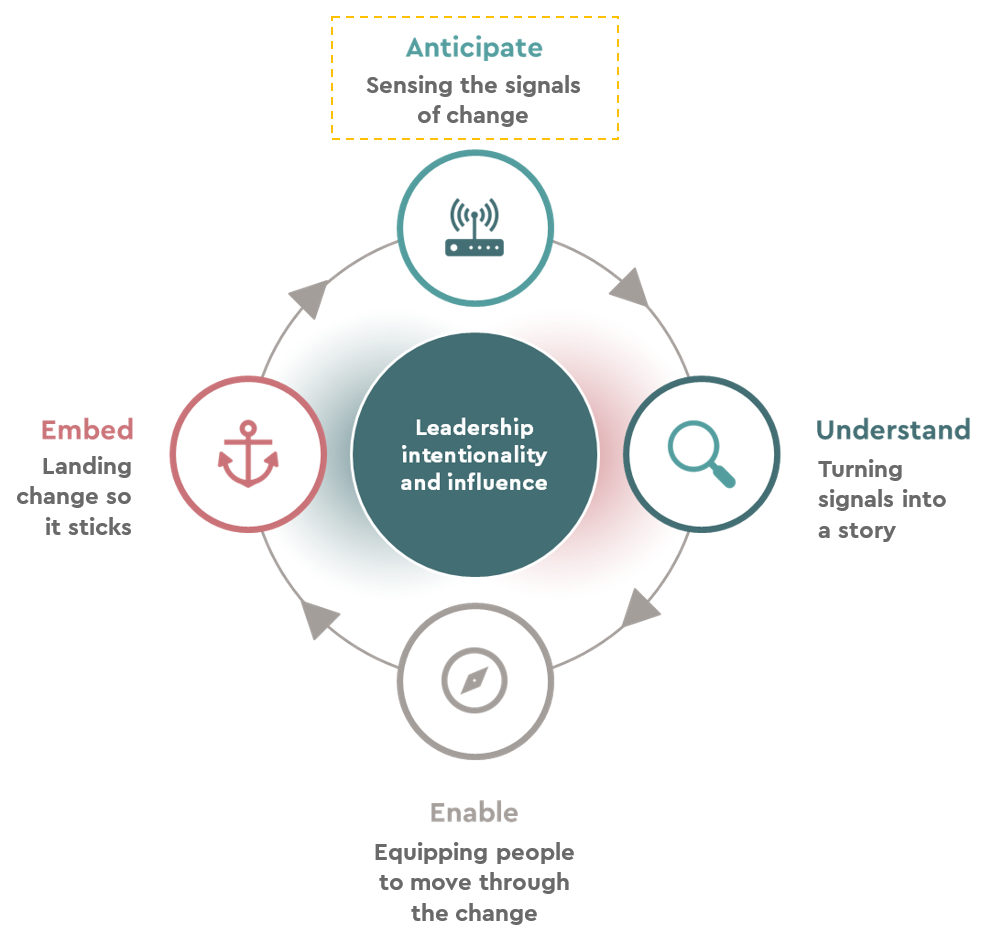
That part of the experience can be easy to miss because it’s less structured and often less visible. But because it can shape what follows in important ways, it’s an area where leaders can also have a big impact.
Ultimately this is about building trust and engagement with people at the earliest opportunity, before the real work of changing the organisation begins. Creating that initial trust will help to accelerate the adoption process and make the change stick.
People’s past experiences will shape how they look at change now
While people are picking up various changes in behaviour, language, and tone, they’re comparing notes with colleagues and looking for patterns, trying to understand what is going on.
They’re also interpreting those signals through past experience. People bring with them memories of previous restructures, reform efforts, budget decisions, and leadership responses.
Those experiences stay close to the surface, particularly where the person was directly affected in some significant way. The same signal can therefore land very differently for different team members.
Leaders need to show up earlier
This is where I think leaders need to be more deliberate. Because early interpretations can settle quite quickly, and shape how people approach what follows, leaders’ visibility during this period carries extra weight.
People don’t expect complete answers from you at this point. In most public-sector settings, they know decisions take time. What people are looking for is a sign that leaders acknowledge the shift in the environment, and that they’re prepared to engage with the team even though many details are still being worked through.
If leaders don’t step in here, the silence leaves people to fill in the space themselves. Once that starts happening, leaders are no longer deliberately shaping the early experience of change.
Talking to people early on about the changes going on shows that leadership is present and gives the team something more grounded to work with. It also signals that the organisation is taking the human side of change seriously, alongside the formal process.
.jpg)
Make time to acknowledge people’s concerns and responses, including your own
I talked through an example of this at one of our firm’s recent breakfast events focussed on change.
An executive team I’d been working with was preparing for a significant transformation and had started to notice some hesitancy across the organisation, and to some extent among themselves. That hesitation stemmed mainly from how previous change had been experienced. In other words, there were some old battle scars.
Rather than pushing straight into the next phase, the leaders made time as an executive team to explore the lessons they were carrying forward from earlier change. They reflected on what had worked, including where their people’s trust had been strengthened, and where their confidence had dropped away.
They then took this kōrero to their people. It took a bit of courage to open up like that and show some of their own vulnerability, but it set the tone for how they would lead their people through the coming changes.
The uncertainty didn’t disappear, but people could see that their experience had been recognised.
Leaders need to lean in when the signals are first emerging
So for leaders who can feel these shifts beginning in their own organisation, the first task is straightforward: be visible earlier.
Start by acknowledging what people are most likely already noticing. Be explicit that priorities are moving, but that there’s still uncertainty. Then do some listening: create room for hearing what your people are reading into the situation and what past experiences may be shaping their responses.
Give people what information you can, but also enough of your time and energy for them to know that leadership is present and paying attention. None of this requires over-sharing or speaking out of turn, but it does require leaders to be willing to engage before the formal process catches up.
Leaders have more influence over the early experience of change than they sometimes realise. That influence is strongest when the signals are first emerging and the vibe has started to shift – that’s the time to lean in.