
Partner Sarah Baddeley looks at what new climate adaptation legislation and flood-risk research from New Zealand Infrastructure Commission | Te Waihanga mean for those who plan, deliver, and govern infrastructure in Aotearoa New Zealand.
Two recent documents, read together, mark a turning point in how New Zealand governs climate adaptation.
The first is the Climate Change Response Amendment Bill, which puts local adaptation planning into primary legislation for the first time. The second is a research report from New Zealand Infrastructure Commission | Te Waihanga, “When waters rise: Climate change, regional risk and infrastructure investment”, which quantifies flood risk to our infrastructure and buildings with a level of regional detail we have not had before.
Together, the Bill and the report convey three messages that those involved in infrastructure planning, delivery, or governance need to hear: risk can now be measured, accountability is being deliberately localised, and support from central government should no longer be assumed.
The proposed planning obligations are real, and they have deadlines
The new Bill would require territorial authorities to adopt adaptation plans for priority locations identified through regional spatial plans under the Planning Bill (expected to pass this term).
These are not aspirational strategies or hand-waving exercises. The Bill proposes that the adaptation plans must cover at least 30 years out, explain the options chosen to respond to climate-related natural hazard risk and the reasons for them, establish triggers and thresholds for response, and set out indicative costs and, critically, how the council intends those costs to be met.
There are also provisions for how to treat hazards that span different council boundaries. This is sensible, especially for catchment-related risk management, and it raises questions related to boundaries (you can read more about this in an article by my colleague Tessa McGregor).
The adaptation plans must be adopted through the special consultative procedure, reviewed at least every 10 years, and reported on to the council. The timeframes are firm. For priority group 1 locations, councils must start developing their plan within a year after the regional spatial plan is notified, and adopt it within five years.
Councils that have already invested in adaptation planning can seek approval for existing or substantially completed plans. This is a sensible recognition of work done in places like Hawke's Bay, Buller, and South Dunedin.
Adaptation planning is moving from discretionary good practice to statutory obligation, with the Minister holding the extension powers rather than councils holding the timetable.
The numbers now exist, and they should shape decisions
The research from Te Waihanga, which is built on modelling by Earth Sciences New Zealand, gives a consistent, quantified baseline. Average annual loss (AAL) from flooding to infrastructure sits at around $450 million a year. Coastal losses are projected to almost double by 2075, and inland losses to rise by around half, most of that by 2045.
The distribution matters more than the totals. Hawke's Bay faces losses at more than double the national average as a share of asset value, and most regions face higher proportional losses today than Auckland is projected to face in 2075, even under the most severe climate scenario. We have seen this across our work for local government, where financial capacity is not necessarily where the natural hazard risks fall.
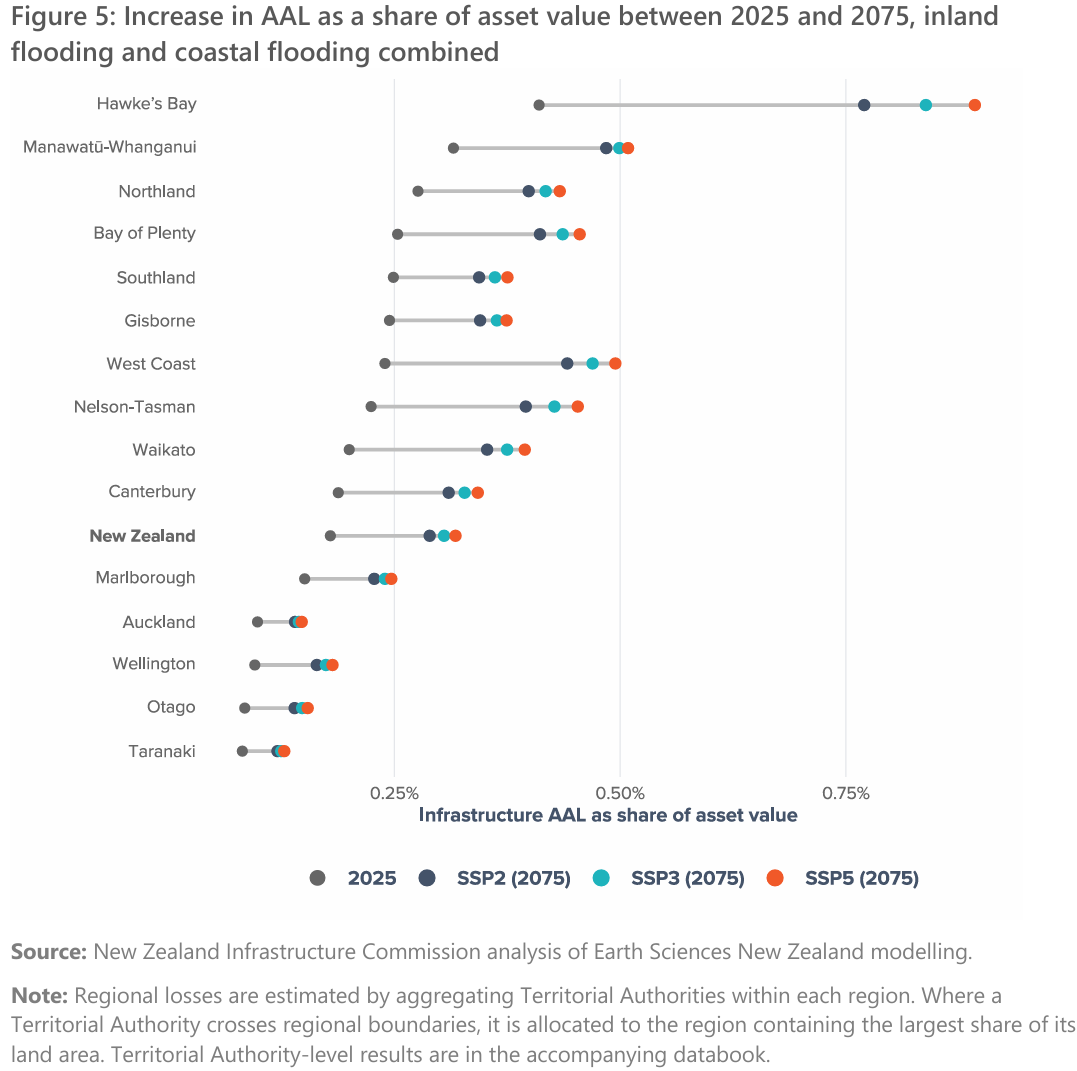
This graph is from “When waters rise: Climate change, regional risk and infrastructure investment”, Te Waihanga, July 2026
Two disciplines follow for anyone at a council or board table. First, treat natural hazard risk as an asset management question rather than a separate planning problem. Te Waihanga observes that depreciation exceeds AAL by at least a factor of five across every sector. The most damaging hazard facing infrastructure owners is time, not water. That argues for building resilience into renewal programmes rather than stand-alone capital bids, and for reporting expected annual loss as a standard performance measure.
Second, use average annual loss (AAL) as a benchmark for choices. Where the annual cost of protection, insurance, or hardening is lower than expected annual loss, intervention most likely represents value for money. Where it is higher, accepting the risk and planning the response, including not rebuilding, may be the more defensible position. Governors who cannot show they have tested their strategy against this logic will find their decisions increasingly hard to defend to auditors, insurers, and communities.
.jpg)
Don’t presume the Crown will pay
The most consequential words in the Climate Change Response Amendment Bill are the quietest: adaptation plans must set out who will be expected to pay. That is not incidental drafting. The Treasury's advice to the Minister of Finance, “Climate adaptation: Priorities for future work” (T2024/584, released under the Official Information Act), names the moral hazard created by the Crown's discretionary post-event support as a regulatory failure in its own right, alongside uncertainty over who will decide and pay for retreat.
The Treasury's warning is blunt: the fiscal costs of climate extremes could threaten long-term fiscal sustainability. The ad hoc pattern of the past, with some $20 billion for Canterbury and $4.7 billion allocated after the 2023 North Island weather events, cannot simply be extrapolated as more frequent events arrive. The Treasury's case is for a clearer, pre-committed split of recovery costs, so that councils, asset owners, and households can face the consequences of their own decisions. Treasury carried this thinking forward in its Long Term Insights Briefing| Te Ara Mokopuna, which it dedicated to focussing on the role of fiscal policy through shocks and business cycles.
The Bill gives effect to that advice. By requiring plans to state how costs will be met before an event, central government is pushing responsibility for adaptation choices, and their costs, to territorial authorities and, through them, to property owners and communities.
For decision makers, the implications are important. Councils must now have regard to adaptation plans in long-term planning and financial strategy, so adaptation costs must be carried explicitly rather than parked as unquantified risk. A council that adopts a plan with trigger-based responses has effectively pre-committed future budgets, and elected members need to understand this before they vote, not after the first trigger event.
If the Crown will not underwrite retreat or protection as of right, the choices are rates, targeted rates, user charges, or reduced levels of service. None is politically easy. All are easier to raise early, through the consultation the Bill requires, than in the aftermath of an event.
The insurance market is moving faster than the statute book
Te Waihanga notes, almost in passing, that where insurance is unavailable or unaffordable, decisions about resilience investment become harder. That understates what is happening. Insurers are moving to risk-based pricing at property level, and the gap between what communities assume is insurable and what the market will carry at an acceptable premium widens with every renewal cycle.
The Treasury takes the point further, citing research suggesting that around 10,000 coastal properties in our main centres could become effectively uninsurable by 2050, with acquisition as a response costing in the order of $10 billion. The Treasury regards the price signal as useful for adaptation, but is explicit that pressure on the Crown to backstop insurability is a fiscal risk to be managed, not a commitment to be assumed.
Insurance retreat is the market's adaptation plan, and it moves faster than any statutory process. Decision makers should treat premium trends and availability in their district as an early warning, and use their new planning obligations to get ahead of it.
From frameworks to decisions
The framework is taking shape: quantified risk, statutory planning obligations, localised accountability, and a market that’s already repricing.
The work required now is disciplined and unglamorous. Know your numbers, embed them in asset management, be honest with your community about who pays, and adopt plans that will survive both a review and a flood.
The waters are rising either way. The question is whether our governance rises with them.
MartinJenkins advises central and local government on climate adaptation, infrastructure strategy, and local-government reform.