

Across Aotearoa, new water services organisations are moving from concept to reality. Some will assume responsibility for delivering drinking water, wastewater, and in some cases stormwater services on 1 July this year, with the rest following on 1 July 2027. Jessie Larsen and Emma Pennington-Foley share their thoughts on how water companies can be ready to run from Day 1.
For those charged with governance or leadership of the new water services companies and their establishment programmes, the question has changed from what should be built, to what must be ready when the baton changes hands.
Operational readiness is where the ambitions of those leading establishment programmes meet day‑to‑day reality. It’s also where traditional approaches to programme management can come unstuck.
Water services companies are being established under tight timeframes, close public scrutiny, and evolving regulatory settings. Many are inheriting assets, data, contracts, and people from multiple councils, and the consequences if services are disrupted through the transfer are significant.
In this transition, planning for and monitoring operational readiness is non-negotiable. Readiness shouldn’t be seen as a single milestone, but as an ongoing process that provides line of sight between what capabilities are being built now and whether those capabilities are ready to run on Day 1.

Four questions to ask now
If you’re governing or leading the programme to establish a water services company, or overseeing the transition of services from councils, these are the questions you should be asking now:
- What genuinely needs to be ready on Day 1, and what can follow? And are those distinctions understood and agreed by the governance and establishment teams and the incoming water company board and management?
- Are we ready for the obligations that begin immediately after go‑live? These include assurance and regulatory requirements like information disclosure that depend on systems, data, and capability being in place from the outset.
- How confident are we that the organisation can operate safely, legally, and credibly from Day 1? Confidence needs to be built on evidence, not optimism.
- Do our programme plans describe the business we need to run, or do they only describe activities and deliverables? Are you clear about the business group outcomes and activities you must deliver from Day 1, and the capabilities you need to support them?
If you find these questions hard to answer clearly, that’s usually a signal you need to bring your planning for operational readiness into sharper focus.
%20SMALL.jpg)
.jpg)
What we’re seeing across the establishment programmes
Through our work supporting establishment programmes for new water companies, and also drawing on our experience with other large-scale organisational transformations, our teams have noticed a consistent set of themes across water companies’ planning and delivery.
Clear ownership makes a marked difference
When operational readiness sits between the establishment team and incoming company leaders, gaps appear quickly. Programmes that appoint a single owner for the operational readiness view are better able to surface risks early on and act on them.
The baton change needs to be planned, not assumed
Many establishment teams will disband or be significantly reduced shortly after go‑live. Organisations that explicitly plan for the transition between establishment and ongoing leadership can be more confident that critical knowledge and decisions will be carried through.
Day 1 isn’t the only day that matters
Some of the most consequential obligations begin shortly after go‑live, not on the day itself. Regulatory requirements for information disclosure are a good example. These requirements rely on having high-quality data, the right system configuration, and capable people. Leaving these until after go‑live often means leaving them too late.
Confidence is stronger when it’s based on capability
Leaders can be more confident when their discussions and planning around readiness are anchored in whether the organisation can perform its core functions, rather than simply whether a list of activities has been completed.

Flipping the view: From deliverables to capabilities
Planning for operational readiness requires looking at your establishment work through a different lens. Programmes need to move away from tracking readiness through workstreams and milestones alone, and answer a different question:
What capabilities does the organisation need to run this part of the business on Day 1, and are they in place?
An operational readiness approach is designed to make that shift. Rather than starting with programme activities, it starts with the business functions that must operate, such as asset management, capital delivery, network operations, customer services, and regulatory compliance.
It then looks at the key outcomes and activities the business function must deliver, and the capabilities – like people, processes, systems, data, and governance – that are needed to assess whether those functions can operate as intended.
This capability‑based view does three important things:
- It brings the perspectives of customers and business owners into the readiness discussions.
- It highlights gaps that may be invisible in traditional programme plans based on workstreams and deliverables.
- It gives boards and executives a clearer, more practical line of sight to risk.
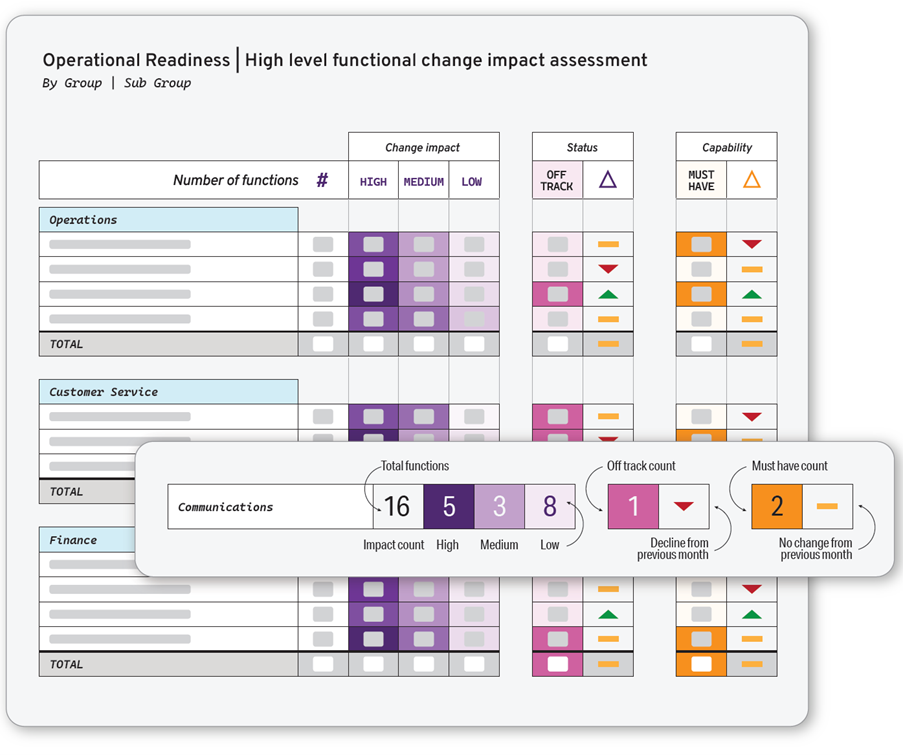
Tools like our operational readiness heatmap (below) support this by translating complex establishment activity into a simple, shared picture of where attention is most needed.
Getting ready to run starts now
Operational readiness isn’t about perfection. It’s about being honest about what’s ready, what’s not, and what the organisation will have to manage carefully in its first months of operating.
For new water services companies, getting this right is about more than good planning. It’s foundational to the safety and reliability of these essential services, and therefore to having the trust of the public and the confidence of regulators. Operational readiness planning is a critical tool for boards responsible for overseeing complex establishment and transition programmes and operating under tight timeframes, particularly in this context where responsibilities of councils and the new companies may be blurred.
As commencement dates approach, the most effective leaders will lift their gaze from programme plans and ask, repeatedly:
Can this organisation run on Day 1, and in the weeks that follow?