

Finance Minister Nicola Willis has previously announced an operating allowance of $2.4 billion for Budget 2026. The operating allowance is typically the headline figure by which a Budget’s generosity is judged – so how does this year’s allowance compare with previous ones? Financial analyst and modeller Aaron Gabbie puts the $2.4 billion figure in historical context.
The “operating allowance” is the pool of net new operating funding available at each Budget for new discretionary policy initiatives or cost increases in existing policies. Put another way, it’s “how much the government has to play with” – that is, the funding available for new policies that might achieve its policy objectives or curry favour with the public.
Like the name says, the allowance covers operating expenditure only, not capital funding for things like hospitals and ships, which are subject to a separate allowance.
The Minister of Finance decides the operating allowance by balancing things such as projected economic growth and the likely tax revenue, the government’s appetite to take on debt (too much debt leads to a higher interest rate), and the level of fiscal discipline the government wants to instil.
Needless to say, it’s a complicated decision with lots of trade-offs, and there’s no “right” number. The bigger the allowance, the more new policy initiatives the government can announce – but the worse off fiscally New Zealand might be in the future. And recent impacts on global energy prices due to military conflict are a reminder that external shocks can quickly alter economic settings.
.jpg)
Is $2.4 billion big or small compared with previous Budgets?
This year’s indicated $2.4 billion is the same as originally signalled for Budget 2025, but lower than the $3.2 billion in Budget 2024, and a lot lower than the $5.9 billion in Budget 2022 at the tail-end of the COVID-19 response.
In that light, $2.4 billion appears to be tight, including in the context of the oil-driven economic shock. In fact, it hasn’t been that low for the best part of a decade. But look back further and the picture is different.
The graph below shows operating allowances since 2005, adjusted to today’s dollars (so the figures are all comparable) and as a percentage of New Zealand’s GDP. As you can see, low operating allowances were common following the Global Financial Crisis, when early economic stimulus soon changed to fiscal restraint to reduce debt. The negative allowance in 2011, one of Bill English’s Budgets, was nicknamed the “zero Budget”.
The allowance began to increase from about Budget 2016, when GDP was growing at a solid 4% per year. The allowance peaked with the tail-end of the pandemic response and Budget 2022, which saw the Treasury forecast deficits over the next four years. Budget 2022 followed massive economic support provided by way of a COVID fund, which allocated $58.4 billion to a range of initiatives.
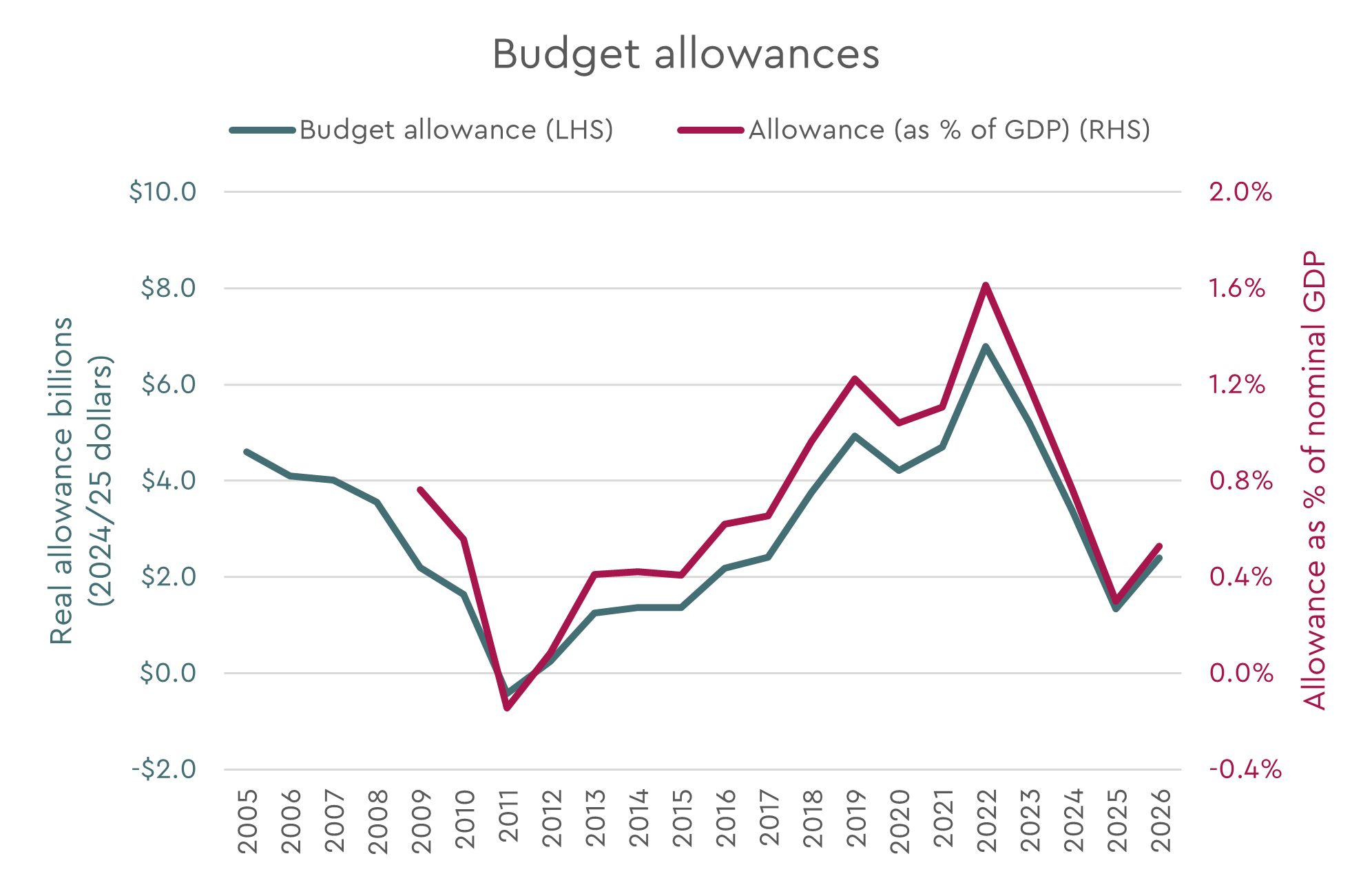
The average allowance between 2005 and 2026 is $2.96 billion (in today’s dollars). Since 2005, there have been nine Budgets with a smaller allowance, and 12 with a higher one. So while this year’s $2.4 billion is smaller than usual, it’s also far from being an outlier. A reversion to the average might be a better descriptor.
So what does $2.4 billion buy you these days?
For some rough comparisons, $2.4 billion was the total export value of New Zealand wine back in 2023, and it was the size of the NZ Super Fund when Michael Cullen started it in 2003. On the New Zealand sharemarket today $2.4 billion is similar to the market capitalisations for each of Ryman Healthcare and Summerset Group.

And to give you some perspective on what $2.4 billion will buy a government in the way of initiatives, here are some from previous Budgets. As you’ll see, a country can’t buy many key initiatives at the same time:
- Budget 2023 allocated an average of $300 million to extend 20 hours of Early Childhood Education to two-year-olds, $150 million a year to scrap the $5 prescription co-payment, and $115 million a year to fund 3,000 more new public housing places.
- Budget 2024’s cuts to personal income tax cost $2.6 billion per year. An average of $442 million was also allocated annually to fund continued access to Pharmac medicines.
- Budget 2025’s “Investment Boost” – a tax incentive to invest in productive assets – cost an average of $400 million per year. Funding of $447 million was provided for urgent health care and after-hours services.
But the Government keeps saying it’s finding savings … Is it spending less then?
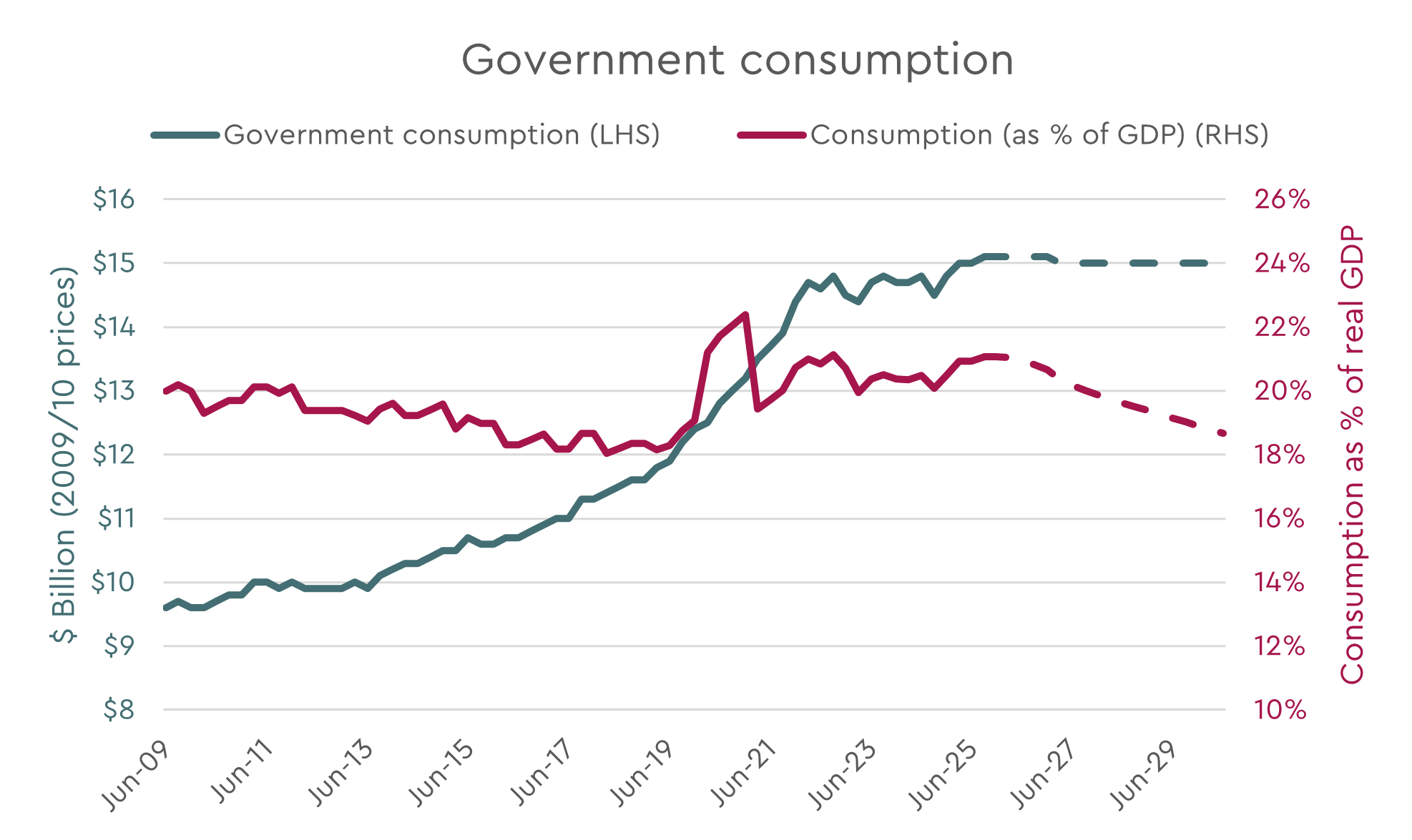
The facts paint a different picture from what you might expect. Operating allowances are cumulative, and many of the COVID-era initiatives remain baked in. The Government’s drive to decrease spending through reducing agencies’ baselines by 6.5% has hit hard, but total government consumption (expenditure minus “transfer payments” like superannuation) is forecast to remain at about the same level as seen since 2022, after allowing for inflation.
Comparing government consumption to GDP shows a big change in 2020, with consumption increasing from a low of about 18% from 2015 to 2019, to between 20% and 21%. Current forecasts see consumption decreasing to about 19% in 2030, back in its medium-term range of 18% to 20%.
Can the Government pull a rabbit out of the hat by cancelling programmes?
The operating allowance is the net amount of new funding – if the Government chooses to stop a programme, it creates savings that can fund something else.
This is what happened in Budget 2025, when the Government turned off an average of $5.3 billion of annual spending, through restrictions on pay equity claims (an average of $2.75 billion a year) and changes to KiwiSaver (about $250 million a year). This enabled it to fund $6.6 billion of new initiatives and cost pressures, a relatively high figure for gross new spending outside of the COVID stimulus era.
Could savings of $5 billion-plus be found again? We’ll find out in time, but it’s difficult to identify potential savings initiatives at that scale without significant policy changes. Finding savings of more than a couple of hundred million dollars from one initiative is unusual, and we’ve seen few examples of this in recent history.
So that leaves us … where?
It leaves us remembering that the size of the operating allowance is always a choice, reflecting a government’s appetite for fiscal restraint. It also leaves us remembering that geopolitical flare-ups, including recent Middle East military activity, underline how fragile forecasts can be.
Budget 2026 appears to reflect this Government’s preferred approach of moderate fiscal constraints and consolidation, which can preserve options if conditions deteriorate.
But even when total funding stays about the same, reallocations can still result in some big winners and big losers come Budget day, in ways that are difficult to anticipate right now several months out.