.jpg)
Sarah Baddeley, Partner at MartinJenkins, looks at the allocation question sitting underneath the current fuel disruption, including who gets guaranteed access, how that is decided, and why the framework matters as much as the fuel itself.
When governments talk about fuel security, the conversation tends to focus on stock levels, shipping lanes, and days of cover. These things matter. But underneath that supply-side picture sits a harder and less discussed question faced by the government: if fuel does become genuinely scarce, who gets it first, and on what basis?
This is an allocation question. It is distinct from the distributional support question from my previous article, which focussed on the question of who receives financial assistance to cope with higher prices. Allocation is more fundamental. It is about physical access to a resource that some parts of the economy simply cannot function without and that others can adapt around more readily than they might initially claim.
Getting the allocation framework right before the pressure intensifies is one of the most important pieces of policy work happening right now. And it is considerably more complex than drawing up a priority list.
The scale of the disruption
It is worth being clear about what New Zealand is dealing with at the global level, because the context shapes the options available to us in ways that matter for domestic policy design.
The International Energy Agency (IEA) describes the closure of the Strait of Hormuz as the largest supply disruption in the history of the global oil market. Around 25% of the world's seaborne oil trade transited the Strait in 2025. Using the IEA’s reported figures, Brent crude futures are up almost 45% since hostilities began on 28 February. Diesel and jet fuel benchmark prices in Asia have more than doubled. Gulf producers have cut total oil production by more than 11 million barrels per day as storage fills and export routes close. There are no meaningful alternative routes for LNG from Qatar and the UAE. Around one-fifth of global LNG trade has simply lost its exit path.

On 11 March, IEA member countries agreed to release 400 million barrels of emergency oil stocks – the largest coordinated release in the agency's history. New Zealand, as part of this collective response, is drawing on that international framework. But emergency stock releases buy time rather than resolving the underlying problem. If shipping through the Strait does not resume, supply losses will continue to increase.
The honest starting point for domestic policy design is that New Zealand is a small, geographically remote economy at the end of a long and currently disrupted supply chain, with limited ability to influence the pace of resolution. What we can influence is how we manage what we have, and how fairly and intelligently we allocate it.
The hierarchy is obvious until it isn't?
New Zealand has a reasonably well-developed answer to the question of who gets fuel first. The National Fuel Plan, jointly maintained by MBIE and the National Emergency Management Agency (NEMA) and updated in 2024, sets out a critical customer framework that identifies the sectors with priority access to fuel in a disruption. The list includes health and disability services, emergency services, lifeline utilities, corrections facilities, agriculture and food supply chains, public transport, welfare services, and the NZDF. It is a serious piece of planning work, and it matters that it exists.
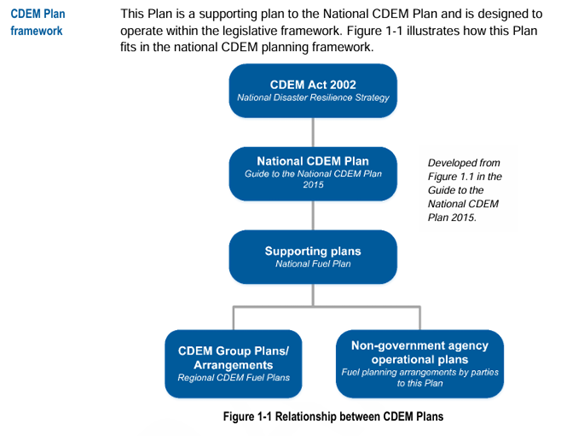
But reading the Plan carefully reveals just how much complexity sits underneath that list. The critical customer categories are deliberately broad. For example, "transport and storage of food" and "agriculture, including food supply chain, milk collections, preventing animal welfare issues, crops, fisheries, and activities of significant economic export value" are both on the list. But translating those categories into actual named organisations, with verified fuel requirements and a means of identifying their vehicles and staff at the pump, is the work that falls to regional Civil Defence Emergency Management (CDEM) Groups.
The Plan is also candid about the identification problem. There is no national system for pre-approving critical customer vehicles or staff. Individual fuel retail outlets, often unmanned and card-operated, are not set up to make rapid judgements about who qualifies for priority access. The Plan notes that fuel station staff are neither resourced nor trained to manage prioritisation processes, and that fuel companies will close retail outlets if there are health and safety concerns. In a fast-moving disruption, that is a real constraint that policymakers are navigating.
Lifeline utilities sit across the critical customer list in ways that are not always visible until they fail. Water and wastewater treatment plants, pumping stations, telecommunications infrastructure, and electricity networks all depend on diesel back-up in an extended outage. The Plan explicitly notes that a major emergency is likely to bring a significant increase in demand for generator fuel, compounding pressure on diesel supply at exactly the moment when diesel is already scarce. The interdependencies run deep: a fuel disruption can cause power outages, and power outages increase fuel demand for generators, which deepens the fuel disruption.
That interdependency is not theoretical right now. As this article is being written, Northland and Auckland are experiencing heavy rain, much of Northland is without power, and generators are running. The National Fuel Plan was updated in 2024 partly in response to exactly this kind of scenario. The 2023 Cyclone Gabrielle response revealed gaps in how independent fuel retailers and regional distributors were integrated into the response framework. They have since been added permanently to the Fuel Sector Coordinating Entity. That is the kind of practical learning that good emergency planning should produce.
What the Plan makes clear is that the hierarchy of priority is not a simple ranked list that can be read off a page and applied mechanically. It is a framework that requires active management, real-time judgement, and coordination across a large number of agencies and private-sector actors working together to manage the challenge.
.jpg)
The inelastic demand problem
Beyond the obvious essential services, there is a category of economic activity where fuel demand is simply not elastic in any meaningful sense. This is not a matter of preference or efficiency, but a structural feature of how certain industries operate.
A dairy farmer cannot choose to delay milking because fuel is expensive or hard to get. A fishing vessel that has committed to a season cannot easily tie up at the wharf because diesel costs have spiked. A manufacturing plant with continuous production processes – for example, glass, steel, cement, or food processing – cannot pause and restart at will without incurring costs and risks that may be as damaging as the fuel disruption itself.
The IEA material adds another dimension worth noting here. The global disruption is particularly acute for middle distillates such as diesel and jet fuel, precisely the products that these inelastic demand sectors run on. The IEA notes that markets for middle distillates were already relatively tight before the conflict, and that there is little flexibility for refineries outside the Gulf region to increase output to compensate. For New Zealand, this means the products most critical to our agricultural sector, our trucking fleet, and our aviation connections are under the greatest supply pressure globally and we are seeing this play out in the price of diesel overtaking the cost of unleaded 91 in parts of the country. That is not a coincidence to be managed around, it is a central fact for domestic allocation design.
Fertiliser, food, and second-order effects
IEA material also flags the direct relationship with fertiliser that is so critical to our primary industries. More than 30% of global urea trade and around 20% of global ammonia and phosphate trade moves through the Strait of Hormuz. These are the inputs that New Zealand's agricultural sector depends on for the fertiliser that underpins pastoral productivity.
A fuel disruption that is managed reasonably well at the pump level could still have significant consequences for New Zealand's primary sector if fertiliser supply chains are disrupted over a longer period. The seasonal nature of fertiliser application, like in the dairy sector, means this is a time-sensitive risk. An allocation framework focussed purely on liquid fuel may miss the broader supply-chain vulnerabilities that a prolonged disruption would expose.
This is a good example of why the allocation question is harder than it first appears. The direct fuel dependency is visible and relatively easy to map. The indirect dependencies are less visible, often longer in their lead times. This will be at the heart of the operational policy design around any response, as the unanticipated consequences are potentially more damaging if they are not identified early.

The verification challenge
One of the practical difficulties with any priority allocation system is verification. Establishing that a business genuinely falls into a priority category, and that the fuel it is claiming access to will actually be used for the stated purpose, requires information that government agencies do not always hold in readily accessible form.
During the COVID-19 response, similar verification challenges emerged repeatedly. Businesses claimed eligibility for support they did not always qualify for. This was not always through bad faith but often because the eligibility criteria were drawn broadly and the systems for checking them were not built for speed. An allocation framework for fuel would face the same tension between moving quickly and checking carefully.
There is also a geographic dimension. Regional supply disruptions, where a particular port or distribution terminal is affected, require location-specific data that is often not held centrally or in real time. The systems that would need to underpin a regional allocation response are not, in most cases, systems that currently exist in the form they would need to. This will be particularly acute when thinking about the different needs of our different regions, including Auckland, relative to other parts of the country. We certainly found that during the COVID period.
The role of price and the limits of rationing
One of the questions that tends to generate the most debate in a supply disruption is whether price should be allowed to do some of the allocation work, or whether formal rationing is the right response.
The case for allowing price to adjust is straightforward in theory. Higher prices signal scarcity, encourage conservation, and direct fuel towards its highest-value uses. This is especially attractive as it does not require government to make millions of individual allocation decisions. The case against is equally straightforward in practice. Allowing price to ration fuel in a genuine shortage (without any form of targeted government support) means that access becomes a function of ability to pay, which produces outcomes that most people would regard as unacceptable for essential services and basic needs. This plays out for businesses as well as individuals and households. Right now, electric car owners are feeling a little relieved.
The honest answer is that neither pure price rationing nor pure administrative allocation works well in a real disruption. The most defensible approach is probably a hybrid: allowing price signals to operate for discretionary uses while maintaining administrative priority frameworks for genuinely essential services and inelastic demand sectors. But designing that hybrid approach, including drawing a clear line between the two interventions, so that it is enforceable and perceived as fair is hard. This is exactly the kind of work that needs to happen before the situation demands it.
Introducing restrictions before there is clear evidence of a genuine shortage adds friction without adding fuel. But having the framework ready – including knowing how it would work, who would administer it, on what legal basis, and according to what priority order – is a different matter entirely.
What good preparation looks like
The countries and jurisdictions that manage supply disruptions best tend to share certain characteristics. They have thought through their priority frameworks in advance. They have maintained relationships with fuel importers and distributors that allow for rapid information sharing. They have legal frameworks that can be activated quickly without requiring new legislation under pressure. And they have a clear understanding of which parts of their economy are genuinely vulnerable and which are more adaptable than they initially appear. Against these tests we should be feeling pretty good.
Our participation in the IEA's coordinated stock release also demonstrates the value of the international institutional frameworks that have been built up since the 1970s. The IEA was founded in 1974 precisely in response to the oil shock of the previous year. The machinery it has developed for collective action exists because individual countries working alone are poorly placed to manage disruptions of this magnitude. New Zealand's membership of that system is not a passive arrangement, it is an active asset in a situation like this one.
But we are still a little country at the end of the world, economically reliant on trade and tourism.
What the international framework cannot do, however, is make the domestic allocation decisions that a genuine shortage would require. That framework is not something that can be improvised well under pressure. It is the kind of work that rewards prior investment heavily – the quiet, unglamorous process of mapping dependencies, testing assumptions, building operational plans, and ensuring the legal authorities are in place to act when needed.
This article reflects the author's independent analysis of publicly available material. It should not be read as representing the views of any government agency, minister, or client of MartinJenkins.